The Material Report #013
Tariff day
By the time you read this, the 10% tariff that has sat on nearly every import since late February is gone. It expired at midnight under the terms of the law that created it, which capped it at 150 days, a limit the President can't extend and Congress didn't try to. Its replacement started the same minute. Before the details: no, your steel didn't get cheaper. The metals tariffs are a different law, and they didn't move.
The new tariff, announced Thursday afternoon and effective at 12:01 this morning, comes under a different trade law, one with no cap on the rate and no expiration date. Thirty-eight countries, including China, Vietnam, Brazil, and Russia, now pay 12.5%. Seventeen countries that ban or restrict forced-labor imports pay 10%. One surprise on that list: India, which had been slated for the higher rate, made the tier alongside Canada, Mexico, and the UK. If you buy Indian tooling or stock, that's a small break that wasn't in the proposal. For the EU, Japan, Korea, and a few others, the new rate folds in the normal base duty instead of stacking on top of it, so the sticker number overstates the change.
Two short windows are open right now. Goods already on the water, loaded before today, clear at the old rates if they're entered before July 28, so if you have a shipment in transit, this is the week to make sure your broker files it fast. And the USMCA exemption carried over: Canada and Mexico goods that qualify stay exempt, which makes this the right week to confirm your certificates are current.
About the metal point from up top, here's why the two are separate. The metals tariffs work by product: steel, aluminum, and copper pay 25~50% under a national-security law with no expiration, no matter which country they come from. The new tariff works by country: it covers nearly everything else those 60 countries ship, based on where it's from. Anything already under the metals law is exempt from the new one, so nothing pays both tariffs at once. For your receiving dock, the split is: raw stock and metal-heavy parts didn't change price at midnight, and the new rate applies to the rest, tooling, machinery, fixtures, consumables.
Two housekeeping items while you have your broker on the phone. Brazil went the other direction this week, a new 25% duty took effect Wednesday, with an escape hatch only for goods already on the water (loaded before Wednesday, entered before July 29). And keep your paperwork: every dollar of the 10% you paid since February 24 is potentially refundable, because the court ruling that found it unlawful in May is still alive on appeal, and importers from the earlier round of tariffs this one replaced have already had more than $80 billion in refund claims accepted. The importers who got paid fastest had organized entry records. Ask your broker to pull your February-through-July entry summaries now, while it's a five-minute job.
Steel: the plateau, and the first cracks
Nucor tried a $5 increase two Mondays ago, to $1,135 a ton, then held it there this week. That's the new pattern: two flat weeks, a token increase, another hold. The market average SMU tracks hasn't moved from $1,160 in three weeks. After five months where the only question in steel was how much more, the market has gone sideways, and Nucor's own June guidance points to its best quarter in over a year, so the sideways isn't coming from mill distress. Earnings come out Monday, same day as the next price letter, and together they'll say whether this plateau has legs.
Plate is still the exception it's been all summer. Nucor announced a $60 increase for its September order book, SSAB's $40 hits shipments starting August 2, and spot availability stays thin. If you buy plate, none of this applies to you.
The new development is at the demand end. Liberty Steel furloughed most of the roughly 300 wire-mill workers at its Bartonville, Illinois plant, blaming a downturn in industrial fencing. SSAB is permanently closing its Toronto cut-to-length operation. And national raw steel output just posted its lowest week since April. Two closures and one soft output number don't make a downturn, but they're the first distress signals in this report all year, and they matter precisely because list prices haven't budged. Sticky prices over softening demand is a squeeze on somebody, and it usually finds the smaller operations first.
From our benchmark
New this issue: a quick read on what the distributor list prices we track daily, more than 3,200 stock metal products, actually did while the headlines were moving.
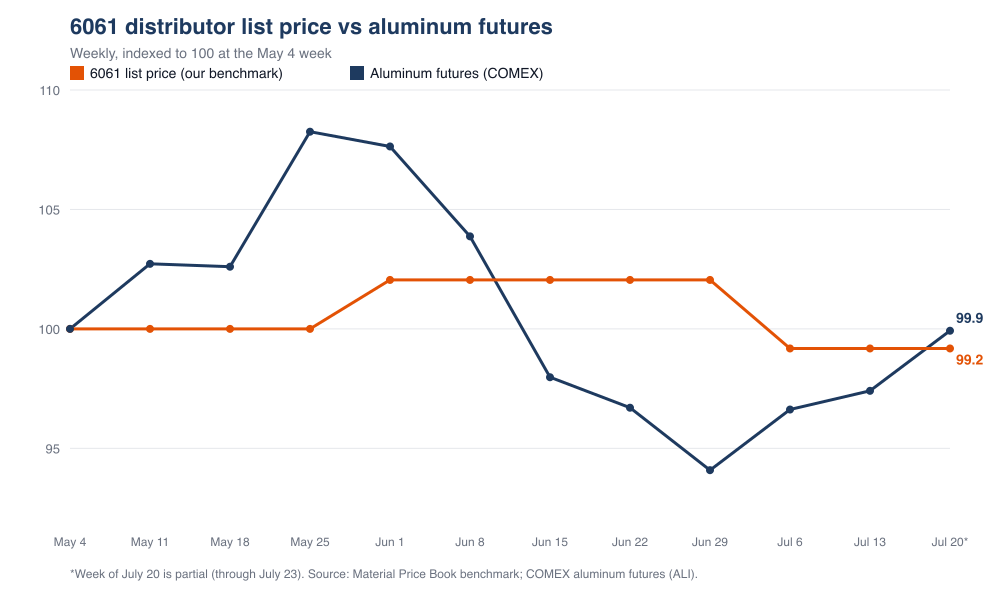
Aluminum is the cleanest story. Since early May, futures rode a full round trip: up 8% into a late-May peak, down 13% from it, and by this week (still partial) back to where they started. The 6061 list prices in our benchmark barely moved in either direction, up 2% in early June, then one 2.8% step down in early July, $4.98 to $4.84 a pound. 7075 went the other way, up 5.5% in the June 8 week and unmoved since. Sticky on the way down, quick on the way up.
Steel's plateau arrived product by product. A500 tube went flat in the June 8 week, two weeks before Nucor's pause. A36 plate kept climbing, up about 4% since the pause. 1018 cold-finished bar peaked in the June 29 week and has given back about 5% through the July 13 week (the current week is partial). The two biggest 14-day moves: large-diameter hot-rolled round bar repriced down about 36%, and low-carbon hot-rolled flat bar rose about 13%.
June's stainless surcharge increase hit the price list in full within two weeks on 304, about $0.10 a pound against a $0.08 surcharge bump; 316 passed through about two thirds. Surcharges are heading down now, and the next few issues will test whether decreases travel to the price list as fast as the increases did.
The war premium came back
Three issues ago the war premium came out. Last issue it was trying to come back. This week it came all the way back. The US has now hit Iran thirteen straight nights, Iran's Revolutionary Guard declared the strait "completely closed" after another tanker was set ablaze, and the Houthis widened the fight, striking Saudi tankers in the Red Sea to enforce a blockade of Saudi ports. Tanker traffic through Hormuz is down to about 10 transits a day against a prewar norm of 120~140. Brent settled above $100 on Thursday for the first time since late May, up 7% in a day and roughly 40% in three weeks.
That matters beyond the pump, because June's inflation report, the one with the biggest monthly price drop since April 2020 and annual inflation cooling to 3.5%, was mostly a photograph of the ceasefire. The photograph is now out of date. With Brent back over $100 and the national average gasoline price past $4 a gallon, treat June's cooldown as the bottom, not the trend. The Fed decides Wednesday, and markets lean toward a rate hike this fall rather than cuts, which puts the costlier-money squeeze from earlier issues back on the table. Diesel bottomed near $4.58 a gallon in early July, and with crude up almost $30 since, expect the pump number and your fuel surcharges to climb through August.
Pricing notes
Copper hit a five-week high around $6.48 a pound while the tariff decision it's waiting on runs three weeks overdue. June 30 was the deadline for the report to reach the President, not for the decision, and no signed order has appeared. Some read the delay as the decision getting kicked down the road, others as the setup for a yes, which Goldman thinks would send copper to new records. Don't position on either. One real deadline regardless: starting July 30, certain imported copper wire and cable entries must report where the copper was smelted and cast, so if you bring those in, your broker needs origin data ready. Brass (C360) tracked copper sideways. Bronze is too thin in our benchmark this cycle to support a call, so no call.
Aluminum's index sits around $3,100~$3,150 with exchange warehouse stocks at their lowest since 2022 and buyers paying extra for metal now versus metal later. That combination is real near-term tightness. The Abu Dhabi smelter restart is ahead of schedule but running at about 7%, with full recovery still months out. A re-escalating war makes aluminum the quickest metal to snap higher, same as the last three issues, and the gap between what the index does and what the price list does is exactly what the benchmark section above measures.
Stainless: nickel sits at six-month lows in the low $16,000s, and Indonesia's decision on raising its mining quota, the thing that would push nickel lower still, has a July 31 deadline. August surcharges publish within the week and should ease again. If you're booking 304 or 316, ask for the August surcharge before accepting July's.
Carbide: China's tungsten feedstock is back to where it started the year, but European prices, the ones your tooling is actually priced against, are still up around 240%. Kennametal reports in early August, and that call, not the Chinese spot price, is where real surcharge relief would show up first. Same position as last issue: no relief call until a company that sells inserts says so.
Steel is covered up top.
What I'm watching
The new rates are hours old, so double-check anything your broker quotes this week against the official notice. And the second tariff investigation, the one on excess manufacturing capacity, is still open, so this isn't necessarily the last word on rates this year. Monday is the next big day, Nucor's weekly letter and its second-quarter earnings arrive the same day, and they'll say whether the plateau holds and how the mills see the second half. The Fed decides Wednesday. July 31 brings the pharma tariff and Indonesia's nickel deadline, August 1 the next read on factory input costs, and Kennametal reports in early August. IMTS runs September 14~19 in Chicago, and with machine orders running about a third higher than last year, expect a crowded show.
If today's tariff change shows up anywhere on your invoices in the next few weeks, up or down, email me. One line is plenty. The gap between what the law says and what shows up on price lists is the whole reason the benchmark section exists.
Buying metal for an upcoming job, or trying to beat a high quote? Send me your spec and I'll pull 3~4 supplier quotes with lead times in 2~3 business days. First RFQ is free. (Already have a quote in hand? Run it through Quote Check.)

Eric Na writes The Material Report, a bi-weekly newsletter on metal pricing trends for machinists and shop owners.
Get the next Material Report in your inbox
Twice-monthly benchmarks, trend analysis, and market context written for shops and small buyers.
Sources
- Tech Times, "Section 122 Expires Friday: Brazil Duty Hits Wednesday, Section 301 Looms" (July 20, 2026)
- Congressional Research Service, "Legal Authority for Section 301 Tariffs to Address Forced Labor and Excess Manufacturing Capacity" (July 21, 2026)
- Tariffs Tool, "Section 301 Replacing Section 122: 12.5% on 46 Countries" (July 2026)
- Tariffs Tool, "Section 122 Expires July 24, 2026: Rates After + 3 Scenarios" (July 22, 2026)
- USTR, "USTR Takes Action in Forced Labor Section 301 Investigations" (July 23, 2026)
- Global Trade Alert, "Forced-Labour Section 301 Tariffs on 60 Economies Take Effect on 24 July" (July 24, 2026)
- Steel Market Update, "Nucor holds spot HR price at $1,135/ton" (July 20, 2026)
- GMK Center, "Nucor has resumed raising prices for hot-rolled coils" (July 13, 2026)
- IndexBox, "Nucor Raises Hot-Rolled Coil Price to $1,135 per Short Tonne" (July 2026)
- SMU, "News briefs: Nucor plate increase, SSAB Toronto" (July 16~17, 2026)
- Kallanish, "Liberty Steel & Wire furloughs Bartonville workforce" (July 2026)
- 25News/WMBD, "Hundreds face furloughs at Liberty Steel & Wire's Bartonville plant" (July 11, 2026)
- AISI, "Industry Data, Weekly Raw Steel Production" (July 2026)
- OilPrice.com, "Brent Breaks $96 as U.S. Strikes Iran for 12th Consecutive Night" (July 22, 2026)
- Bureau of Labor Statistics, "Consumer Price Index, June 2026" (July 14, 2026)
- Federal Reserve, "FOMC Meeting Calendar" (July 2026)
- Congressional Research Service, "Section 232 National Security Tariffs on Copper Imports" (2026)
- Trading Economics, "Copper" (July 2026)
- Trading Economics, "Aluminum" (July 2026)
- Trading Economics, "Nickel" (July 2026)
- Trading Economics, "Brent Crude Oil" (July 2026)
- EIA, "Gasoline and Diesel Fuel Update" (July 2026)
- North American Stainless, "Flat Products Surcharge" (July 2026)
- China Tungsten Industry Association, "Tungsten Prices Fall Back to End-of-2025 Levels" (July 7, 2026)
- Material Price Book, "Price Movers" (July 2026)